
![]() |
National Center for Constitutional Studies |
||||||
![]() |
"A primary object.should be the education of our youth in the science of government. In a republic, what species of knowledge can be equally important? And what duty more pressing.than.communicating it to those who are to be the future guardians of the liberties of the country?" -George Washington |
![]() |
|||||
|
|||||||
America's Founders knew that it takes more than a perfect plan of government to preserve liberty. Something else is needed - some moral principle diffused among the people to unite and strengthen the urge to peaceful observance of law. They recognized that the raw materials of a free government are people who can act morally without compulsion, who do not willfully violate the rights of others, and who love liberty enough to demand that government's power is very limited. They used the word "virtuous" to describe such people. Defined by Webster, "virtue" is "a conformity to a standard of right," but whatever word is used to describe it, such a moral standard is the necessary fountainhead of a free society. The Declaration of Independence referred to "Nature's God," the "Creator," the "Supreme judge of the World," and "Divine Providence" Our nation's founders came together, voluntarily, to create a limited government to secure for them and posterity their God-given rights to life, liberty, and property. Such liberty, they believed, rested on three great supports:
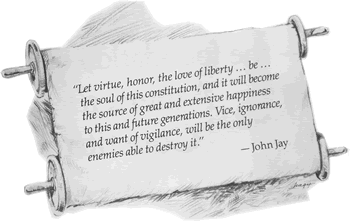
Their own words are eloquent reminders of their devotion to this belief:
And Alexis de Tocqueville, the French statesman who traveled across America in the 1830's and wrote a two-volume study entitled "Democracy In America," is widely quoted as observing:
|
|||||||
Home | Store | Newsletter | U.S.I.Q. - Game | You Can Help | Contact Us |
|||||||